AI Agents in 2026: How Autonomous AI Is Changing the Way We Work
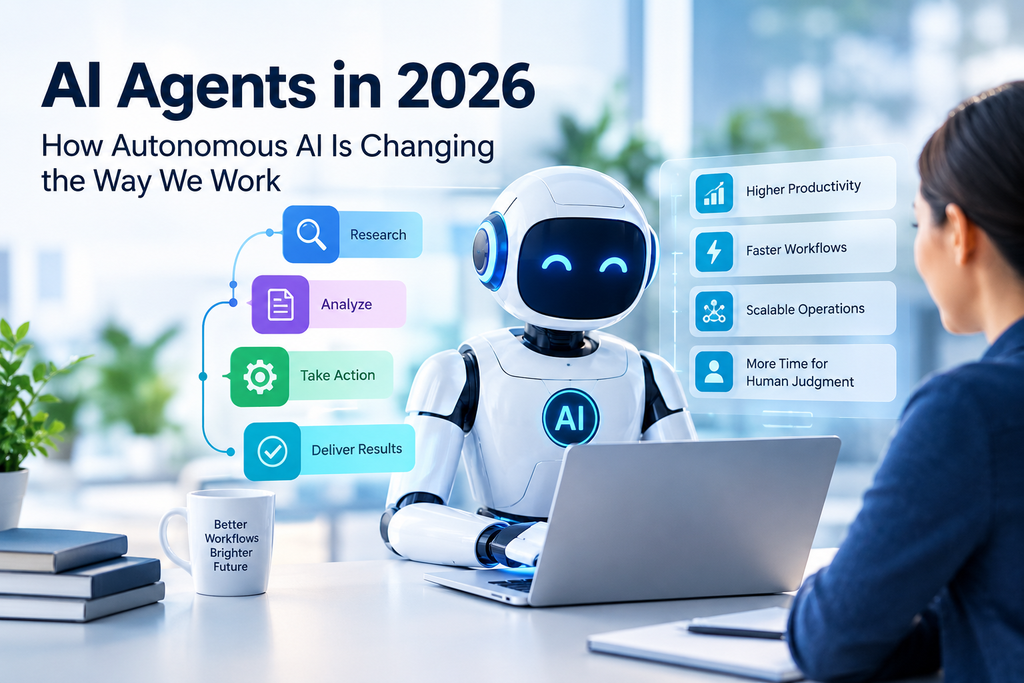
Artificial intelligence is moving beyond chatbots that simply answer questions. In 2026, AI agents are increasingly designed to understand goals, use tools, complete multiple steps, and carry out parts of a workflow with limited human intervention.
This shift is often described as agentic AI. Instead of asking an AI system to draft an email, summarize a document, or write a piece of code and then doing everything else yourself, an AI agent can potentially handle a larger sequence of related tasks.
The change is already visible in workplace AI. OpenAI’s 2026 Enterprise Signals research describes enterprise AI as moving from assistance toward execution, with agents increasingly connected to organizational context, tools, and repeatable workflows.
But autonomous AI does not mean that humans are becoming irrelevant. The more capable an AI agent becomes, the more important questions around oversight, permissions, accuracy, security, and accountability become.
What Are AI Agents?
AI agents are software systems that can pursue a defined goal by reasoning through tasks, using tools, accessing relevant information, and taking actions within an allowed environment.
A traditional chatbot generally waits for a prompt and responds. An AI agent can be designed to take a broader objective and work through several steps toward that objective.
For example, a conventional AI assistant might answer:
“Here is a summary of these sales reports.”
An AI agent could potentially be given a broader workflow such as reviewing reports, identifying unusual changes, organizing the findings, preparing a draft update, and sending it for human approval.
The important difference is execution.
AI Assistant vs AI Agent
| AI Assistant | AI Agent |
|---|---|
| Primarily responds to prompts | Works toward a defined goal |
| Usually performs individual tasks | Can coordinate multiple steps |
| Human directs each interaction | Can operate with greater autonomy |
| Limited tool interaction | Can use connected tools and systems |
| Focuses on assistance | Focuses on assistance plus execution |
The exact capabilities vary significantly between AI products. An agent should therefore be evaluated based on what it can actually access, control, verify, and execute rather than simply being described as “autonomous.”
Why AI Agents Are Becoming Important in 2026
Several developments are pushing agentic AI from an experimental concept toward practical workplace applications.
OpenAI reports that enterprise AI is increasingly being used for delegated work rather than only question-and-answer assistance. Its June 2026 data found that agentic AI use was spreading beyond software development into functions including legal, sales, recruiting, and marketing.
Microsoft’s 2026 Work Trend Index similarly focuses on the changing relationship between workers and AI agents, arguing that as agents take on more execution, people can spend more time directing work, making decisions, and owning outcomes.
These developments point to an important change: the value of AI may increasingly come from how well it fits into a workflow, not simply how well it generates text.
How AI Agents Work
At a basic level, an AI agent combines several capabilities.
1. Goal Understanding
The agent first needs to understand the objective.
A goal might be:
- Research a market topic.
- Organize incoming customer requests.
- Review a set of documents.
- Prepare a software-development task.
- Monitor a workflow for specific conditions.
A clearly defined goal is important because an AI agent needs boundaries around what it is supposed to accomplish.
2. Planning and Reasoning
The agent may break the objective into smaller tasks.
For example, a research workflow could involve:
- Identifying relevant information.
- Gathering documents.
- Extracting useful facts.
- Comparing information.
- Producing a structured result.
- Sending the result for review.
The quality of this process depends on the model, tools, available context, and the design of the workflow.
3. Tool Use
Tool access is one of the major differences between a basic chatbot and a more capable AI agent.
An agent may be connected to tools such as:
- Business databases
- Document repositories
- Software-development environments
- Communication platforms
- Search systems
- Internal knowledge bases
- Business applications
However, access should be limited to what the agent actually needs. Giving an autonomous system unnecessary permissions can increase operational and security risks.
4. Action and Execution
Once an agent has enough information, it may execute approved actions.
This could include creating a document, updating a record, organizing information, or preparing a task for human approval.
The crucial point is that autonomy should be bounded. An AI agent should not automatically receive unlimited authority simply because it can perform a task.
AI Agents in the Workplace
One of the most important applications of AI agents is workplace automation.
AI Agents for Business Workflows
Businesses have traditionally automated individual tasks. Agentic AI creates the possibility of connecting several tasks into a larger workflow.
Consider a hypothetical customer-support process.
A conventional automation system might route a support ticket according to predefined rules.
An AI agent could potentially:
- Read the customer’s request.
- Identify the issue.
- Search approved internal documentation.
- Draft a response.
- Check relevant account information.
- Escalate unusual cases.
- Record the interaction.
A human could remain responsible for reviewing sensitive or high-impact decisions.
This approach changes automation from task automation to workflow orchestration.
AI Agents for Marketing and Sales
Marketing teams can use agentic workflows for research, content preparation, data organization, and campaign operations.
Sales teams may use agents to organize account information, prepare meeting materials, summarize customer interactions, or support repetitive administrative work.
OpenAI’s enterprise data indicates particularly rapid growth in agentic usage among several non-engineering functions, including legal, sales, recruiting, and marketing.
The important distinction is that these figures describe usage within OpenAI’s enterprise data rather than the entire global workforce. They should therefore be treated as an indicator of changing usage patterns, not as a universal adoption rate.
AI Agents for Software Development
Software development has been an important early environment for AI agents because software tasks often provide structured context and measurable outputs.
An agent can potentially inspect a codebase, modify files, run tests, identify errors, and prepare changes for human review.
This does not remove the need for developers. Instead, it can shift some developer time from manually completing every step toward specifying tasks, reviewing results, debugging difficult problems, and designing systems.
What Are the Benefits of AI Agents?
The potential benefits of AI automation go beyond saving a few minutes on individual tasks.
Higher Productivity
AI agents can handle repetitive sequences that would otherwise require repeated manual actions.
Faster Workflows
When an agent can move between multiple steps without requiring a new prompt for every action, some workflows may become faster.
Better Scalability
A well-designed workflow can potentially handle more tasks without increasing manual effort at the same rate.
More Time for Human Judgment
When routine execution is delegated, people can focus on decisions, exceptions, relationships, creativity, and accountability.
Microsoft’s 2026 Work Trend Index frames this as a shift in human agency: as AI takes on more execution, workers can potentially spend more time directing work and owning outcomes.
The Risks of Autonomous AI Agents
Greater autonomy also creates new risks.
Accuracy and Reliability
An AI agent can make mistakes across multiple steps. A small error early in a workflow can affect everything that follows.
For that reason, organizations need appropriate verification mechanisms rather than assuming that an autonomous system is correct.
Security and Privacy
AI agents may interact with company information, customer data, documents, or business applications.
That makes permission management especially important.
An agent should have access only to the information and systems required for its assigned task.
Accountability
When an AI agent makes a mistake, organizations need to know who is responsible for the workflow and how the decision can be reviewed.
This is why human oversight remains important even as AI systems become more autonomous.
Integration Challenges
AI agents cannot transform a workflow simply by being added to it.
They need appropriate data, tools, permissions, context, and processes.
Recent reporting on enterprise AI adoption highlights this challenge. Reuters reported on October 1, 2026, that many companies were struggling to move AI projects beyond pilot stages, with regulatory barriers and legacy technology integration among the obstacles identified in the cited study.
How Businesses Can Prepare for AI Agents
Start With the Workflow, Not the Technology
Before selecting an AI agent, identify the process that needs improvement.
Ask:
- What task is repetitive?
- Where do delays occur?
- Which decisions require human judgment?
- What information does the workflow require?
- What actions should remain human-controlled?
This prevents organizations from adopting AI simply because the technology is available.
Define Permissions and Human Review
An AI agent should have clearly defined boundaries.
For example, an organization might allow an agent to prepare an action but require a person to approve it before execution.
This approach can provide automation while maintaining accountability.
Measure Real Outcomes
AI adoption should not be measured only by how many prompts employees submit.
Useful measures can include:
- Workflow completion time
- Error rates
- Service quality
- Task completion
- Human review time
- Customer outcomes
- Cost or resource requirements
The appropriate metrics depend on the workflow and business objective.
The Future of AI Agents
The future of AI agents in 2026 and beyond is unlikely to be defined by one universal “AI employee.” Instead, organizations are likely to experiment with specialized agents designed for particular tasks and workflows.
Some agents may focus on research. Others may support software development, customer service, sales operations, administration, or internal knowledge management.
The larger transformation is architectural: businesses are beginning to consider how AI systems can move from generating information to participating in processes.
What Will Human Workers Do?
Humans will continue to play important roles in setting goals, evaluating results, handling exceptions, making high-impact decisions, and taking responsibility for outcomes.
As AI agents become more capable, skills such as critical thinking, domain knowledge, communication, verification, and AI workflow design may become increasingly valuable.
The objective should not be to remove humans from every process. It should be to determine which parts of a process AI can perform reliably and which parts require human judgment.
Human Oversight Still Matters
Autonomous AI works best when autonomy has boundaries.
A useful AI workflow can combine:
Human goal → AI planning → AI execution → automated checks → human review → final outcome
This model keeps people involved where judgment, accountability, or risk requires it.
The Practical Rule for AI Automation
Automate the repeatable. Review the consequential.
That principle can help businesses explore AI agents without treating autonomy as an end in itself.
Final Thoughts on AI Agents
AI agents represent a significant evolution in workplace AI. Instead of using artificial intelligence only to generate answers, organizations can increasingly connect AI to tools, information, and repeatable workflows so it can participate in executing work.
The opportunity is substantial, but successful adoption requires more than installing an AI agent. Businesses need clear workflows, reliable data, appropriate permissions, human oversight, measurable outcomes, and governance.